
Kanban Self-Organization - Part 1
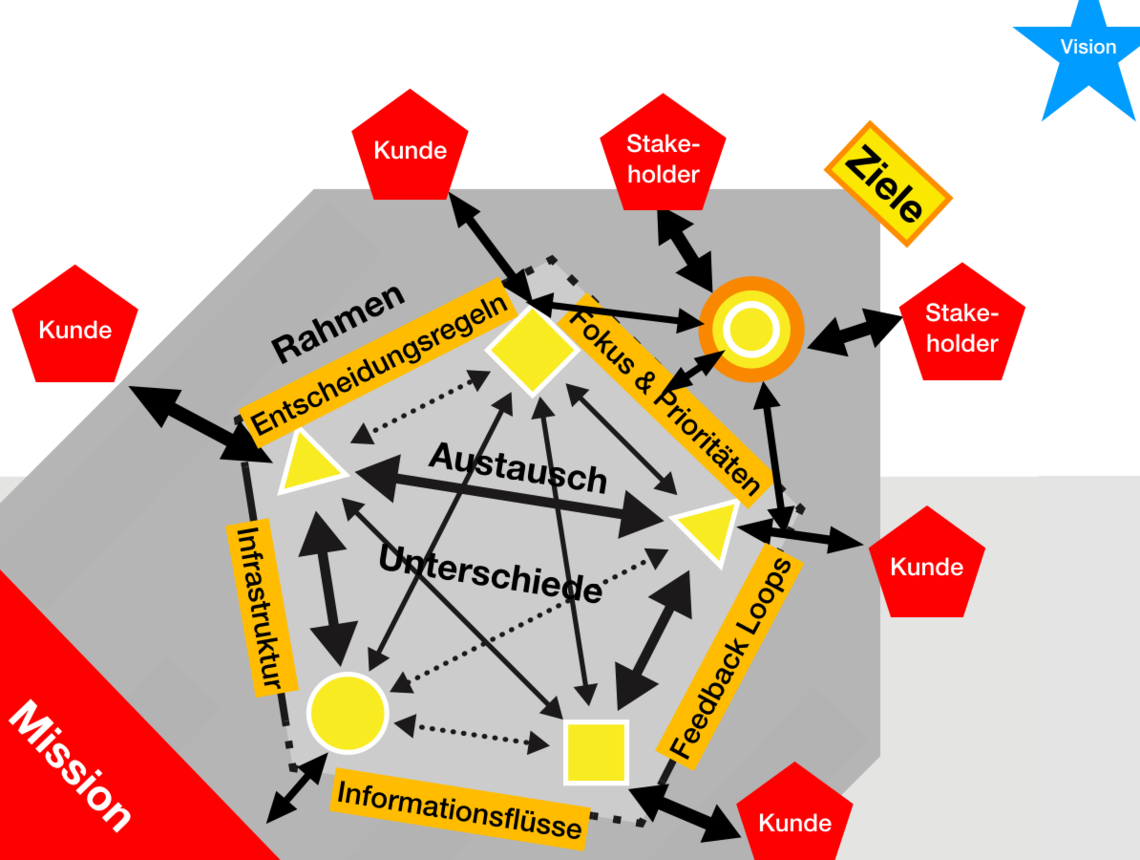
"Manage the work; and let people self-organise around it", postulates Kanban for knowledge work. The cornerstones of this management approach are well known: Basic principles like evolutionary change, customer focus or leadership at all levels, core practices like visualization, WIP limits or feedback loops. So far, so good. But what exactly does the second part of the postulate mean? How do people come to organize themselves? Why does it even matter? And who has to do what exactly to allow - or even specifically promote - self-organized work?
This is the first of three article parts in which I would like to provide answers to these questions. After a short definition of self-organization, I first want to situate the entrepreneurial use of Kanban and clarify what the combination of Kanban and self-organization actually aims at.
What does self-organization mean here?
Self-organization is not only one of the most popular, but also one of the most misunderstood concepts in the agile world. What smells like kindergarten to some, or even like monkeys suddenly running the zoo, seems to represent some kind of miracle cure for others. "The best architectures, requirements, and design merge from self-organized teams," the agile manifesto already asserts, and the Scrum Guide programmatically states that development teams "structured and empowered (to) organize and manage their own work"
But what exactly does self-organisation mean? How does it come about? And what impact does it have on leadership and management? The first two questions are easy to answer. From a systemic perspective, self-organization is anything but a miracle. Rather, it is the natural way in which global order emerges - through local interactions between the individual components of an originally disordered system. The American sociologist Glenda Eoyang names three prerequisites for self-organization: a boundary that encompasses the respective system and thus defines its identity; differences between the individual components of this system; and internal as well as exchange with the outside world.
These findings can be easily transferred to companies. As I have already explained in detail, it only takes six ingredients to make self-organization taste good:
A powerful mission focused on customer value and translated into strategic goals (see red or red-bordered boxes in Figure 1).
A vision that acts like a guiding star and describes something like the higher ideals of the organization (see the blue star in the upper right).
Frameworks that keep each basic cell on track. This includes all structures and processes that enable the subject matter experts to focus on their work in the best possible way: for example, focusing the work on concrete value propositions and prioritizing them; clarifying decision-making authority; a good infrastructure; transparent information flows; or regular feedback loops (see the orange rectangles surrounding the pentagonal base cell).
Differences in terms of technical know-how, creativity or social competence in order to be able to process complex requirements as efficiently as possible (see the various yellow shapes).
Exchange on a collegial level and with all customers and stakeholders. The main aim here is to get a good grasp of their needs and to identify any changes as quickly as possible (see the black arrows of varying intensity).
Line management that focuses on shaping the context and resists the temptation to interfere in operational events (see orange-yellow-white circle). For, according to the British systems thinker John Seddon "if workers control their own work, they need managers to work on things that are beyond their control but that determine essential framework conditions: the way work takes place. (...) Managers work on the system while team members work in the system" [Seddon 2008, p. 72].
This list inevitably leads to the question of how best to process the various ingredients. What does a recipe for self-organization look like? What does it take of what to combine the existing forces in the best possible way? To unfold the common potentials? And to cultivate continuous improvement in all areas of the company? The short answer is: by designing learning work systems and supporting environments. The longer answer leads us into the realm of visual work management. More specifically, to its concerted use across all areas of the business and the role that self-organised working plays in this. But let's take it one step at a time.
Where does Kanban need self-organization?
Much of the charm of Kanban systems comes from the fact that they can be created using relatively simple techniques. Once work, workflow, and WIP limits are visualized, and operational rules and feedback loops are defined, we're ready to go. The question arises as to why we should rely on self-organized work in the process. What is the point of involving everyone concerned? Even involve them in the design of work processes? Instead of continuing to rely on the specifications of management experts? This smells suspiciously of awkward discussions, along the lines of "actually, everything has been said, just not by everyone yet". Why should we risk such dynamics? Let the efficient techniques be swamped by inefficient emotions? And complicate everything with the human factor, as a colleague once put it so well?
Admittedly: the questions are a bit pointed. However, Kanban practice shows that work techniques dominate and the social side is often neglected (especially in areas where technology also plays a major role professionally, such as in software development). This is by no means to advocate a naïve humanization of work. But as long as we put system mechanics in the center, we risk to overlook the basis of that culture, which we want to create with Kanban. After all, every improvement stands and falls with the people who drive it forward.
The question is, of course, what kind of improvement we have in mind at all. Where should Kanban be used at all? Klaus Leopold's model of the "Flugebenen" (Fig. 3) provides us with a pointed answer: It is about Enterprise Kanban and thus also about a company-wide use of self-organized working. Beyond the operational autonomy of agile teams (Flight Level 1), it is therefore about new forms of cross-team coordination (Flight Level 2) and the strategic portfolio (Flight Level 3) as well as an intelligent linking of the different levels.
But how can such a link succeed? After all, on the one hand, very different goals are pursued at the various fluids levels, and on the other hand, people work there who tick quite differently. Well, despite all the personal, content-related and control-related differences, there are some strong commonalities. First of all, the levels share the same basic principles: Start with what you're doing now, pursue incremental change, encourage leadership at all levels apply equally to portfolio, coordination and implementation. Moreover, similar basic techniques are used at all levels: visualization, limiting, lean meetings, selected measurements, probability-based forecasting, and the like. Moreover, if the self-organization aspect of Kanban is taken seriously, senior managers, team leaders, and subject matter experts also share a common leadership philosophy. At its core, this philosophy means that those who work in a particular work system also shape it. Visual management systems are not designed by methodological gurus ("the agile staff") and hierarchically imposed ("yours sincerely, your agile management"). Rather, they are developed step by step by the subject matter experts themselves. In this way, at least three promises of happiness of self-organized work are fulfilled:
The open exchange of different specialists, as only then can the complex work situation be grasped to some extent appropriately and the associated uncertainty be overcome. How do we perceive our environment? What central challenges do we see? What does this mean for our work? What do we want to pay particular attention to?
Direct contact with customers or their respective representatives to obtain feedback on a regular basis. What is important to the customer? What is particularly important to them? How exactly do they benefit from the products and services we provide?
The connection between work and decision. What do we focus our attention on? What do we notice? What exactly do we want to do more often, less often, not at all or new in the future?
Even if not all employees are constantly involved in such management issues, but delegates from the different areas (as is usual in coordination systems for 80, 150 or even several hundred employees), it is a matter of consistent self-management. The specialists who know their own work best are also the ones who decide on the most efficient form of their work management.
Of course, this must not lead to external requirements being ignored, nor to the experts defining everything on their own. Kanban does not move in a vacuum, but is always subject to certain constraints. Which purpose does the enterprise pursue? What strategic goals does it set for itself? And what is the framework for achieving these goals? However, the combination of Kanban and self-organization very much means breaking with the tradition of paternalism that is still prevalent in many areas. Because as long as project and line managers apply their traditional control mechanisms to kanban systems (resource efficiency, status reporting, individual performance management, detailed planning, push logic, etc.), the potential for improvement will remain manageable.
Kanban and Self-Organization - Part 1